
Leslie State-Custody Path
No adult Kentucky state prison was identified in Leslie County. The Kentucky Department of Corrections is a statewide system, not a county jail, and a person sentenced in a Leslie case may be assigned far from Hyden. Kentucky also uses qualifying county beds for some state-controlled people. A county detention center shown as the current location does not by itself mean that local authority controls the sentence.
A DOC custody ending can lead to parole, Mandatory Reentry Supervision, sentence expiration, or another legal status. A person may also remain confined because of another sentence, detainer, or receiving agency. KOOL’s current location and supervision fields help identify the state relationship, but the actual release or transfer record is the stronger event record.
Search KOOL for Leslie Records
Kentucky Offender Online Lookup, known as KOOL, is the main public state search. The official FAQ advises beginning with a last name and first initial. Add the PID or DOC number when known, then narrow by offender type, supervision status, location, county of supervision, conviction county, offense, or date fields.
- Run a broad name search and compare aliases and identifiers rather than relying on a name alone.
- Open the matching detail and check Current Location, status, conviction county, and DOC or PID number.
- Read Institution Start Date or Supervision Begin and End Date in context.
- Review the parole table without treating a recommendation or proposed date as completed release.
- After the expected event, search again and request the status-change record if precision matters.
An institution or local-jail location ordinarily means custody continues. A community-supervision status with a Probation and Parole location shows a community relationship, not confinement at that office. Probation may arise directly from a court order, while parole and MRS follow state custody. The Post-Release Supervision page explains those distinctions.
Kentucky DOC Date Labels
KOOL uses several date labels that answer different questions. The advanced search includes “Projected Release Date From / To.” A full record may display Expected Time To Serve (TTS), Minimum Expiration of Sentence Date (Good Time Release Date), Parole Eligibility Date, and Maximum Expiration of Sentence Date. The parole table can separately show Proposed Release Date.
| KOOL label | What it indicates |
|---|---|
| Minimum Expiration | A computed sentence date reflecting applicable credit, not proof of completed release. |
| Parole Eligibility | When consideration may become available under governing rules. |
| Maximum Expiration | The outer sentence endpoint as calculated by DOC. |
| Proposed Release | A parole-table date that still requires later event confirmation. |
Do not hand-calculate a Kentucky release from sentence length alone. Jail credit, offense classification and date, consecutive sentences, program or conduct credit, forfeiture, parole action, and outside holds can change the result. For a disputed computation, request the current DOC time-computation record.
Older Leslie DOC Releases
A blank public search is not proof that no Kentucky record exists. The official KOOL FAQ routes inquiries about former offenders from years ago to Offender Information Services. Kentucky’s retention schedule classifies the “Inmates and Releases” record series as permanent. The public interface and the retained agency record therefore have different reach.
Send an older-offender inquiry to Offender Information Services, PO Box 2400, Frankfort, KY 40602-2400. Include the full name, date of birth, aliases, and DOC or PID number if known. State the Leslie conviction or case connection, but remember that conviction county and physical release location need not match.
Request Kentucky Release Records
Kentucky DOC accepts written open-records requests at correctionsopenrecords@ky.gov; the requester should include a mailing address. Offender-record requests may also go to Division of Public Affairs, Attn: Open Records Coordinator, PO Box 2400, Frankfort, KY 40602, or fax 502-564-9575. DOC notes that the email is for records requests, not informal status questions.
Identify the person and request the admission, release or custody-status-change record, maintained release type, transfer destination, and current time computation where relevant. Exclude medical, victim, juvenile, Social Security, and security-sensitive information.
DOC publishes charges of ten cents per released paper page, one dollar plus postage for electronic records on CD, and about $2.50 plus postage for a USB. It sends a payment letter before release. Under the DOC-specific procedure described under KRS 197.025, the agency states that it responds within five business days, excluding weekends and legal holidays, with access, denial, or a delay notice and expected availability.
KOOL Limits and Updates
DOC warns that KOOL data newer than 120 days may not be finalized and does not guarantee complete accuracy. Its FAQ says the system updates four times per day. That supports calling it regularly refreshed, not real time. The same FAQ says KOOL displays only the last ten convictions and that most, but not all, offender records have a photograph.
Compare the conviction county, KRS citation, indictment number, and identity fields to the Leslie case. A status such as “Parole Recommended” is not a door-exit event. Return after the proposed date, check current location, and obtain the actual release record when the distinction matters.
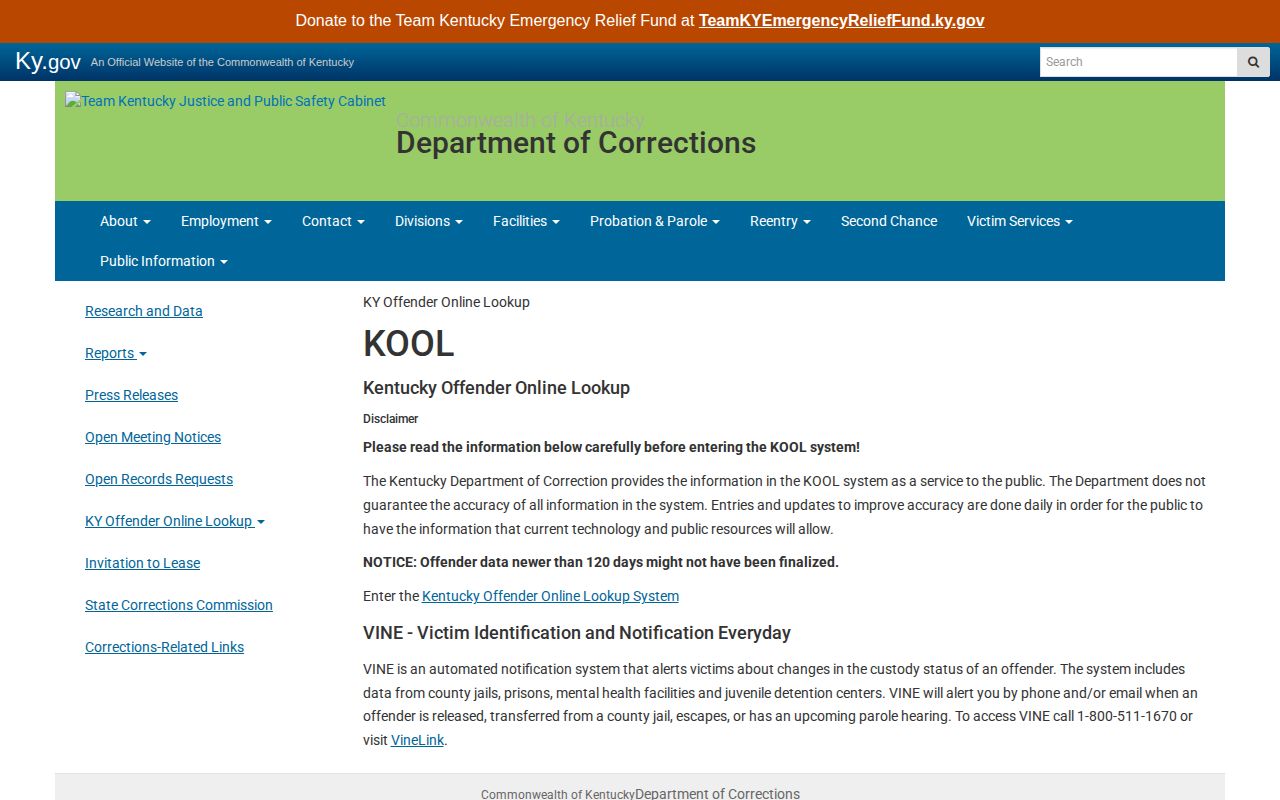
Read the official KOOL entry and disclaimer before using this captured view.
Public Record Search
Sponsored Results
Credits and Actual Release
KRS 197.045 addresses prior-confinement credit, education and program credits, possible good-behavior credit, and limited exceptional-service credit. Credits can be forfeited, consecutive sentences are aggregated, and special rules can restrict use. KRS 439.3401 has an 85-percent minimum for people meeting its detailed violent-offender definition, not every Kentucky prisoner. Parole rules also depend on offense and date.
Mandatory Reentry Supervision can begin six months before projected completion for qualifying people not granted discretionary parole, with exclusions. MRS is community supervision, not a rewrite of the jail release reason. Obtain the individual DOC calculation when a date is disputed.
A Kentucky DOC Daily Releases report for August 21, 2024 named Leslie County Detention Center as a facility. Such reports cover state authority, not every local bond-out, dismissal, pretrial release, or county-sentence completion.
Match the Leslie State Case
KOOL can show aliases, PID and DOC numbers, conviction county, indictment number, KRS citation, crime and conviction dates, sentence length, and current location. Use those fields together. A Leslie conviction may be served anywhere in the state network. County is a case clue, not proof of physical location.
DOC says most, not all, offenders have a photo. Intake images may take several days to appear and are updated at least annually or after a major appearance change. A KOOL photo documents the state record and may not be the Leslie booking image.
For a fully discharged record, pair KOOL with Offender Information Services and open records. Permanent retention means the state release record can survive when the public interface no longer returns the person.
Leslie DOC Verification Ladder
First decide whether DOC controlled the person. Search KOOL and compare identifiers. Read location and supervision fields. Compare the Leslie judgment. If a date is prospective, search again after the event. Request the status-change record when actual date, authority, or destination matters.
VINE can supplement with custody notice, but it is not a time-computation record. The Leslie roster covers local presence, not a statewide sentence. Federal locators apply only to federal or immigration custody.
Kentucky Parole Action Terms
KOOL may show Deferred, Serve Out, Declined Parole, or Parole Recommended. A deferment postpones consideration. Serve-out directs service through completion under the decision. A recommendation permits release if requirements are met but does not prove physical departure.
The Parole Board publishes schedules, while KOOL supplies the action table. Request the written order when needed. Then confirm the actual event through status, location, VINE, or the release record.
Kentucky Data Timing Limits
DOC says KOOL works on updates daily, while its FAQ describes four updates each day. The system warns that data newer than 120 days may not be finalized. Those statements support regular refresh, not real-time certainty. Record the search time around a projected release or supervision change.
KOOL shows only the last ten convictions, so absence of an older Leslie conviction does not prove it never existed. Search precision can also remove the right person when an optional field is wrong. Begin broadly, then narrow after a likely identity appears.
When post-event status remains unclear, request the status-change and release record. A screenshot preserves what the interface displayed, while the agency record supplies the durable source for date, authority, and destination.
For a Leslie County conclusion, preserve the KOOL result, judgment, and requested DOC record together. Their combined dates distinguish sentence calculation, custody status, and actual release.