
Leslie County Projected vs Actual Release
A projected date is a calculation or planning field. An actual release is a recorded custody event. Kentucky dates can change because sentence structure, jail credit, offense classification and date, statutory minimum service, earned credits, discipline, parole decisions, detainers, and later court orders all affect the path.
A person may leave the Leslie County Detention Center for another jail, Kentucky DOC, ICE, or federal custody. That is a transfer, not necessarily community release. Conversely, a state-controlled person may be physically housed in a county jail, so facility name alone does not identify the legal custodian. Use booking, PID/DOC, and case identifiers to follow the right record.
How to Find a Leslie County Release Date
Choose the route by custody type. The official Leslie portal is a current-inmate tool, not a projected-date archive. KOOL is the main public date source for state-sentenced people. The Leslie court and jail records routes are better for a local pretrial or county-sentence event.
- Confirm identity with full name and a second identifier such as DOB, booking number, PID, or DOC number.
- Check the official Leslie current-inmate portal to learn whether the jail presently associates the person with that facility. Absence is not proof of release.
- For Kentucky state custody, search KOOL. Use its “Projected Release Date From / To” range only as a search filter.
- Open the matching full record and read each date by its exact label. Do not collapse several dates into one promise.
- For a pretrial or local court matter, inspect the Leslie case and request the signed bond, release, judgment, or sentence order from the Circuit Court Clerk.
- When precision matters, request the current DOC time-computation and status-change record or the jail’s booking-specific release or transfer record.
- After the projected day, recheck status and location, use VINE, and obtain the actual event record.
The Leslie County release search and records page covers the full named-person confirmation ladder.
Exact Kentucky Release-Date Labels
KOOL uses several labels that answer different questions. Leslie County readers should preserve the wording because a date that concerns eligibility or a minimum is not the same as a scheduled physical exit. Search results and full records also serve different roles.
| KOOL label | Meaning and limit |
|---|---|
| Projected Release Date From / To | A search-range label used to find records with a projected date in that span. |
| Expected Time To Serve (TTS) | The time-to-serve information displayed in the state record, not a release event. |
| Minimum Expiration of Sentence Date (Good Time Release Date) | A computed minimum-expiration field affected by applicable credits and later changes. |
| Parole Eligibility Date | A date for possible parole consideration under controlling rules, not approval or departure. |
| Maximum Expiration of Sentence Date | The displayed maximum-expiration point for the sentence calculation. |
| Proposed Release Date | A field in parole history that remains prospective and must be checked against later action. |
Note: Copy the label with the date so another reader can tell whether it concerns eligibility, sentence expiration, or a proposed event.
Kentucky Credits in a Leslie County Calculation
KRS 197.045 supplies Kentucky’s sentence-credit framework. It recognizes prior-confinement credit as specified by KRS 532.120. It also addresses education and program credits, good behavior, and certain exceptional service. These provisions are subject to the statute and the individual record, so hand subtraction from the sentence is unsafe.
The current statute provides a mandatory 90-day credit for specified approved diploma, degree, or technical outcomes. It permits up to 90 days for each approved drug-treatment, evidence-based, promising-practice, or life-skills program, subject to its terms. DOC may award good-behavior credit up to ten days per month. Exceptionally meritorious service and exceptional emergency service may each support up to seven days per month under the statute.
Except for qualifying jail credit, sentence credits can be forfeited or future earning denied for offenses or rule violations. Consecutive sentences are merged or aggregated for credit and expiration computations. Special sex-offender-treatment provisions can prevent earned credit from being applied before treatment completion. The only safe claim about a named Leslie County person is what the current DOC computation actually applies.
Leslie County Release Dates and the 85-Percent Rule
KRS 439.3401, effective July 15, 2026, applies an 85-percent minimum-service restriction to a person who meets the statute’s detailed violent-offender definition and has a term-of-years sentence. Subsection (5) restricts qualifying violent offenders to identified prior-confinement credit. Certain qualifying life-sentence cases have a 20-year minimum, subject to the precise statutory text.
It is wrong to say that all Kentucky inmates serve 85 percent. The rule depends on classification, offense, crime date, sentence, and applicability provisions. The statute includes dates tied to offenses after July 15, 1998 and a special robbery provision. Confirm the KRS offense, crime date, and current law. A lawyer or Kentucky DOC time-computation record is the reliable source when an individual calculation is disputed.
What Changes a Leslie County Release Date
A date can move earlier or later, or the expected destination can change without the arithmetic date changing. The current computation should be read as a whole rather than treated as a single isolated field.
| Factor | Possible effect |
|---|---|
| Prior-confinement credit | Qualifying jail time can be included under the applicable statutes. |
| Approved program or education credit | An applied credit can affect the minimum-expiration computation. |
| Disciplinary forfeiture | Earned credit may be lost or future earning denied, subject to law and DOC action. |
| Consecutive sentences | Terms are aggregated for credit and expiration calculations. |
| Parole action | Eligibility, deferment, recommendation, denial, or serve-out affects the possible path, not necessarily the sentence maximum. |
| Detainer or hold | Another agency may take custody even when release from the current custodian occurs. |
| Court order | A later judgment, revocation, amendment, or credit ruling can alter the legal basis. |
| Treatment requirement | Applicable treatment provisions can delay use of earned credit. |
Parole, MRS, and Leslie County Date Records
KRS 439.340 supplies general parole-consideration rules. It includes a special early-review formula for certain nonviolent Class D aggregate sentences of one to five years: 15 percent or two months, whichever is longer. Other schedules and restrictions govern other sentences, while 501 KAR 1:030 contains date and offense-specific schedules subject to current statutes and offense-date rules.
KRS 439.3406 provides Mandatory Reentry Supervision six months before projected completion for qualifying people who were not granted discretionary parole, with exclusions. A person on MRS is considered released on parole under that statute. MRS is a community-supervision status. It does not rewrite the historical reason the person left the Leslie jail.
A parole eligibility date permits consideration under the applicable framework. It does not guarantee parole. Likewise, KOOL’s Proposed Release Date can appear in parole history but remains prospective. Read Hearing Action, Months Deferred, Next Parole Eligibility Date, and the later custody status before concluding that release occurred.
Pretrial Leslie County Cases Have No Set Date
A person held before judgment may have no computed sentence-expiration date. Bond, dismissal, acquittal, plea, a later judgment, and other court action can control when custody changes. KOOL’s state sentence fields should not be forced onto a local pretrial booking.
Leslie County belongs to Kentucky’s 41st Judicial Circuit and District. The Office of Circuit Court Clerk keeps both levels’ files. Use the Court of Justice case-search route to identify the case number, then obtain the signed or entered order from the clerk. The current official location is Leslie County Courthouse, 22010 Main Street, Unit 1, Box 7, Hyden, KY 41749. Phones are 606-672-2505 and 606-672-2503, with published weekday hours of 8 a.m. to 4 p.m.
A docket entry is a lead. The signed bond, release, sentence, or revocation order is the stronger court record. The jail’s status-change record then documents when the operational custody event was recorded.
Confirm a Leslie County Actual Release
After the projected date, check whether KOOL now shows a community status, another institution, or a later calculation. Search the matching person in Kentucky VINE and note the reported status and source agency. The Leslie County VINE check also explains how to register for a person-specific alert.
For a state case, ask Kentucky DOC for the current time-computation and release or status-change record. DOC accepts offender-record requests through correctionsopenrecords@ky.gov, with a mailing address included, or by mail to the Division of Public Affairs, Attn: Open Records Coordinator, PO Box 2400, Frankfort, KY 40602. Identify the person by name and DOB or offender ID.
For the Leslie jail, request the existing booking/release or custody-status-change record from the Jailer. Ask for the recorded date and time, maintained release type, and receiving agency if it was a transfer. This last step distinguishes a completed community release from a move that left the person in custody elsewhere.
Kentucky KOOL Date Interface
The official KOOL information page explains the state lookup and its limits.
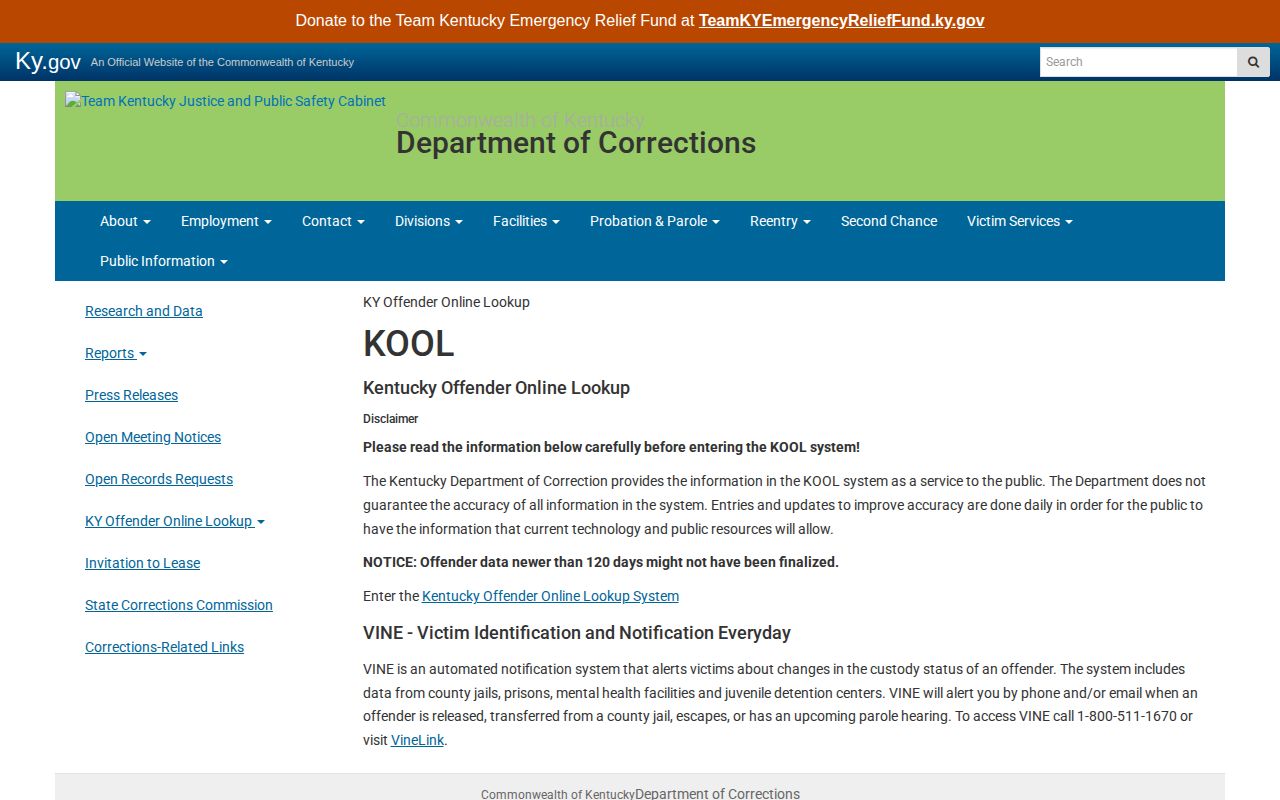
The interface is a route to the current public record, not a substitute for the individual time-computation sheet or actual release event.
Leslie County Historical Release-Date Records
A fully discharged or older Kentucky offender may no longer be easy to find in KOOL. The KOOL FAQ directs questions about former offenders from years ago to Offender Information Services. Kentucky’s state retention schedule identifies the “Inmates and Releases” record series as permanent. A failed online search therefore does not establish that no state release record exists.
For older Leslie County state cases, give Offender Information Services the person’s full name, DOB, and PID or DOC number if known. Its historical-record mailing address is PO Box 2400, Frankfort, KY 40602-2400. A formal DOC open-records request can seek the existing time-computation, release, and status-change records. Narrow the date range and identify the conviction county so staff can distinguish people with similar names.
Local court records may also outlast a short custody display. Request the judgment, sentence, jail-credit ruling, or later order by Leslie case number. Some court material can be sealed, expunged, restricted, or destroyed under the applicable schedule, so absence must be described carefully. Do not reconstruct a lawfully restricted record from unofficial copies. When both state and court records remain available, use the DOC computation for the corrections date and the signed court order for the judicial basis.